For five decades, CAUDIT has served as a unifying force for the Australasian higher education ICT community.
By providing a member-led platform for collaboration, CAUDIT has enabled leaders and ICT professionals to come together around shared challenges, pool expertise and collectively shape the future of digital capability across the sector. What began as informal conversations has evolved into a powerful ecosystem of cooperation, where ideas transition from discussion to action, and where collaboration serves as the catalyst for sustained innovation.
The outcomes of this collaboration are both practical and far-reaching. Initiatives such as the Australasian Higher Education Cybersecurity Service (AHECS), the Higher Education Reference Models (HERM), MortarCAPS, the longstanding Microsoft agreement, the Australian Access Federation (AAF), and CAUDIT’s leadership development programs stand as a testament to what can be achieved when the sector works together.
These programs and frameworks provide shared foundations, reduce duplication, strengthen resilience and enable institutions to focus on what matters most — delivering impact for students, researchers and communities. Together, they demonstrate CAUDIT’s enduring role not just as a convenor, but as a builder of capability, trust and outcomes that extend well beyond individual institutions and continue to shape higher education across Australasia and internationally.
The timeline below outlines some of CAUDIT's key milestones over the last five decades.
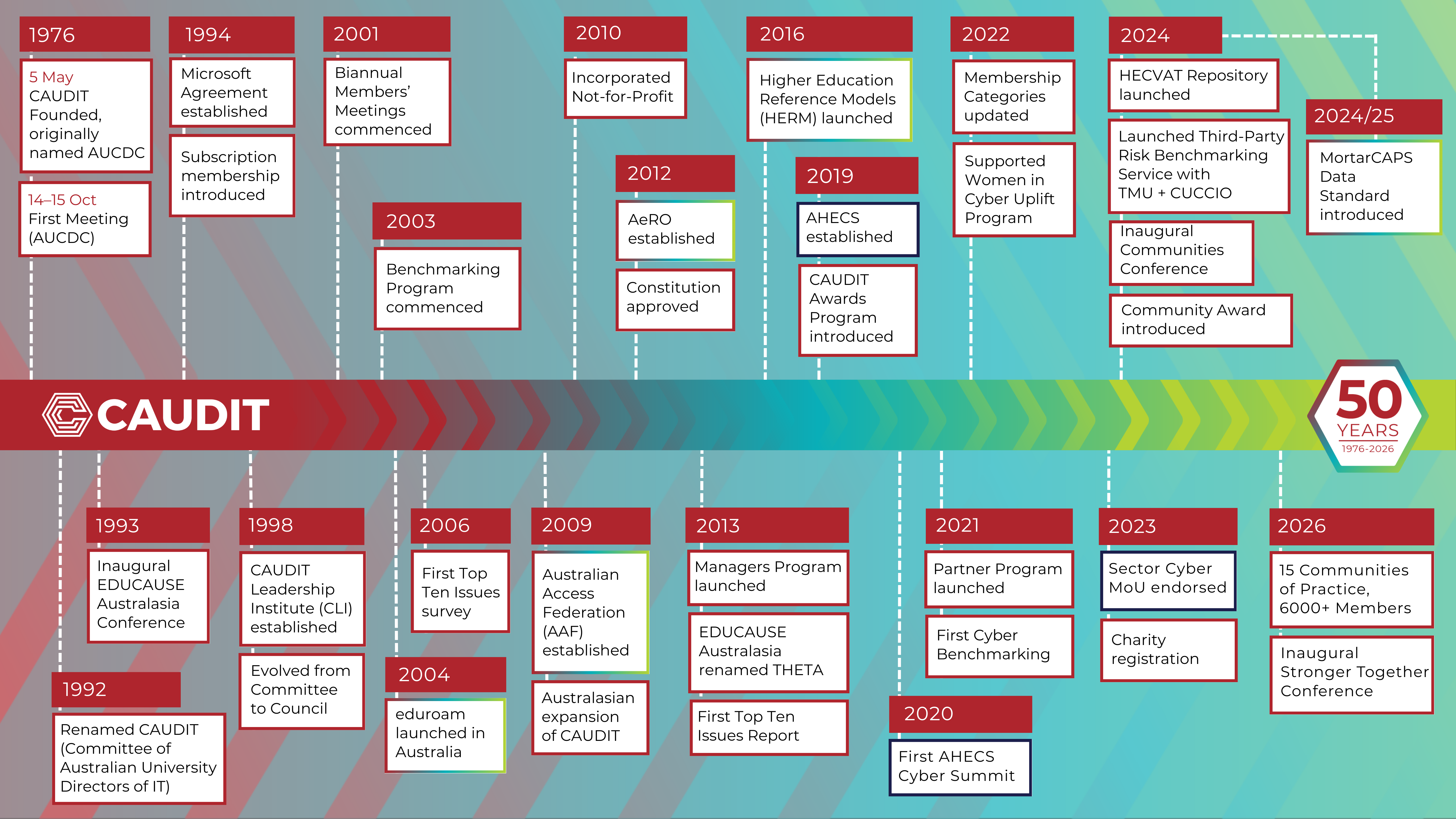
| 1966 | Early Collaboration begins | Informal collaboration between university technology leaders began during the Australian Computer Conference in Canberra, where senior computing representatives from several universities came together. These early discussions laid the foundations for a coordinated, sector-wide approach to ICT leadership that would later evolve into CAUDIT. |
| 5 May 1976 | CAUDIT founded, originally named AUCDC | CAUDIT was formally established as the Australian Universities Computing Directors Committee (AUCDC), creating a national forum for collaboration among university computing leaders. This marked the beginning of a structured, collective voice for ICT leadership in higher education. |
| 14–15 Oct 1976 | First Meeting (AUCDC) | The inaugural meeting of AUCDC was held at the University of Sydney, bringing together founding members to establish shared priorities and governance. This meeting formalised ongoing collaboration and set the direction for future collective initiatives. |
| 1992 | Renamed CAUDIT | At a meeting in Akaroa, the organisation evolved from AUCDC to the Committee of Australian University Directors of Information Technology (CAUDIT). The new name reflected the expanding scope and maturity of the group’s ICT leadership role. |
| 1993 | EDUCAUSE Australasia Conference (later named THETA) | CAUDIT supported the establishment of a major Australasian higher education technology conference, originally linked to EDUCAUSE. This event later became THETA, providing a long‑standing forum for ICT thought leadership, strategy, and innovation. |
| 1994 | Microsoft Agreement established | CAUDIT established a sector-wide Microsoft agreement, enabling coordinated engagement with a major technology vendor, which has continued and saved the sector hundreds of millions of dollars since. This strengthened CAUDIT’s role as an advocate for shared procurement and collaboration. |
| 1994 | Subscription membership introduced | CAUDIT transitioned to a subscription-based membership model, formalising participation and sustainability. This change reinforced CAUDIT’s role as a structured, member-supported organisation. |
| 1998 | Became a Council | The organisation formally shifted from a committee to a council, reflecting its growing influence and authority within the higher education sector. This change signalled CAUDIT’s evolution into a mature peak body for ICT leadership. |
| 1998 | CAUDIT Leadership Institute (CLI) established | CAUDIT launched the Leadership Institute to support professional development for emerging and established ICT leaders. Modelled on international best practice though the EDUCAUSE Leadership Institute, CLI became a flagship leadership program delivered annually. |
| 2001 | Biannual Members Meetings commenced | CAUDIT established regular Autumn and Spring Members’ Meetings, providing consistent opportunities for in person collaboration. These meetings became a cornerstone of member engagement and sector connection across Australia and New Zealand. |
| 2003 | Benchmarking Program commenced | CAUDIT introduced sector-wide ICT benchmarking, enabling members to share data and insights annually. This initiative underpins the State of ICT reporting and supports evidence-based strategic decision making. |
| 2004 | eduroam launched in Australia | CAUDIT played a key role as national policy holder in the rollout of eduroam, with Australia becoming the first non European country to adopt the service. This initiative strengthened secure, seamless connectivity across the higher education sector. |
| 2006 | First Top Ten Issues survey | CAUDIT commenced its annual Top Ten Issues survey, capturing the most significant technology priorities facing members. The survey has become a trusted, sector-leading insight into strategic ICT challenges. |
| 2009 | Australasian expansion | CAUDIT formally expanded beyond Australia to include New Zealand and regional members, adopting its current Australasian identity. This reflected CAUDIT’s growing influence across the wider higher education community. |
| 2009 | Australian Access Federation (AAF) established | Originating from a CAUDIT program of work, AAF was established to provide federated identity and access services. It later matured into an independent not-for-profit supporting national and global research collaboration. |
| 2010 | Incorporated Not-for-profit | CAUDIT formalised its governance by becoming an incorporated not-for-profit association. This strengthened legal standing, accountability, and organisational resilience. |
| 2012 | AeRO established | CAUDIT supported the establishment of the Australasian eResearch Organisations (AeRO). AeRO provides a collaborative forum for institutions delivering advanced research computing and data services. |
| 2012 | Constitution approved | CAUDIT formally approved its constitution, establishing the governance framework still in use today. This milestone clarified roles, responsibilities, and member representation. |
| 2013 | THETA Conference | The EDUCAUSE Australasia conference was renamed THETA and is delivered by CAUDIT in partnership with CAUL and ACODE, reinforcing its position as the premier event for ICT, library and eResearch professionals. |
| 2013 | Managers Program launched | CAUDIT launched the Managers Program to support ICT managers with targeted professional development. The program complements CLI by focusing on middle-managers and operational management capability. |
| 2013 | First Top Ten Report | CAUDIT released its first formal Top Ten Issues report, inspired by the EDUCAUSE model. This publication established a highly anticipated annual output informing institutional strategy across the sector. |
| 2016 | Higher Education Reference Models (HERM) launched | CAUDIT led the introduction of the Higher Education Reference Models in 2016 as a sector driven outcome of collaboration across its Communities of Practice, in partnership with FromHereOn. Designed to support planning, efficiency and digital transformation, the models are now used by more than 1,000 institutions worldwide and translated into eight languages. CAUDIT continues to steward the HERM through an active volunteer working group and international collaboration, with Version 3.1.1 released in mid 2025 and further expansion planned in 2026. |
| 2019 | AHECS established | CAUDIT played a foundational role in establishing the Australasian Higher Education Cyber Security Service (AHECS). CAUDIT leads the delivery of the AHECS body of work, which acts as the sector’s peak cybersecurity body, coordinating shared defence and threat intelligence. |
| 2019 | CAUDIT Awards Program established | CAUDIT introduced an awards program to recognise outstanding contributions to the higher education ICT sector. The program highlights excellence, innovation, and long-term sector impact. |
| 2020 | First AHECS Cybersecurity Summit | CAUDIT led the delivery of the inaugural AHECS Cybersecurity Summit, which now brings institutions together yearly for sector wide dialogue and cyber resilience building. |
| 2021 | First Cybersecurity Benchmarking | CAUDIT expanded its benchmarking activities to include cybersecurity, enabling institutions to assess maturity and risk posture. This initiative supports evidence‑based improvements in sector cyber resilience. |
| 2021 | Partner Program launched | CAUDIT established the Partner Program to foster meaningful, structured engagement between Member Institutions and technology vendors. The program provides a formal pathway for organisations to connect with the CAUDIT member network. This two-way engagement supports collaboration on shared sector priorities while reducing administrative burden for members. |
| 2022 | Membership Categories updated | CAUDIT reviewed and expanded its membership categories to improve inclusivity and representation. Executive roles were opened to full members, strengthening governance diversity. |
| 2022 | Supported the Women in Cyber Uplift program | CAUDIT partnered in the Women in Cyber Uplift initiative, supporting gender diversity and leadership development. The program aligns with CAUDIT’s commitment to sector capability and inclusion. |
| 2023 | Sector Cyber MoU endorsed | CAUDIT led the implementation of a sector wide cybersecurity Memorandum of Understanding. The agreement formalised collaboration and shared responsibility for cyber resilience across higher education. |
| 2023 | Charity Registration | CAUDIT was formally registered as a charity, recognising its public benefit role. This milestone reinforced CAUDIT’s purpose as a not-for-profit sector body. |
| 2024 | HECVAT Repository established | CAUDIT led the development of the HECVAT repository, enabling shared third-party risk assessments. This initiative reduces duplication and strengthens vendor risk management for members. |
| 2024 | Third-party Risk Benchmarking Service established | CAUDIT partnered internationally with CUCCIO and TMU to establish a third-party risk and cybersecurity benchmarking service. The service enhances institutional insight into vendor risk and security posture. |
| 2024 | Inaugural Communities Conference | CAUDIT launched its inaugural Communities Conference, bringing together practitioners from across Communities of Practice. The event highlighted the strength of sector wide collaboration and knowledge sharing. |
| 2024 | Community Award introduced | CAUDIT introduced the Community Award to recognise sustained, high impact contributions to the sector through our Communities of Practice. |
| 2024/25 | MortarCAPS Initiative introduced | Working closely with Ingenuity Partners, CAUDIT played a key role in the development and introduction of the MortarCAPS Higher Learning Data Standard. CAUDIT lead a broad working group to co‑design a unified framework that simplifies complex data environments and supports interoperability. The standard continues to evolve through international collaboration, with multiple releases delivered in 2025 and growing engagement with Canadian and UK partners. |
| 2026 | Communities of Practice – 15 Communities, 6,000 Members | While the community start dates are unknown, CAUDIT’s Communities of Practice now serve 15 distinct disciplines, and support over 6,000 ICT professionals. These communities enable peer collaboration, best practice and capability uplift across the sector. |
| 2026 | Inaugural Stronger Together Conference | CAUDIT launched the Stronger Together Conference, combining the Communities Conference and QuestNet, to support broader collaboration and sector engagement. The event reflects CAUDIT’s commitment to integrated, sector wide collaboration. |